

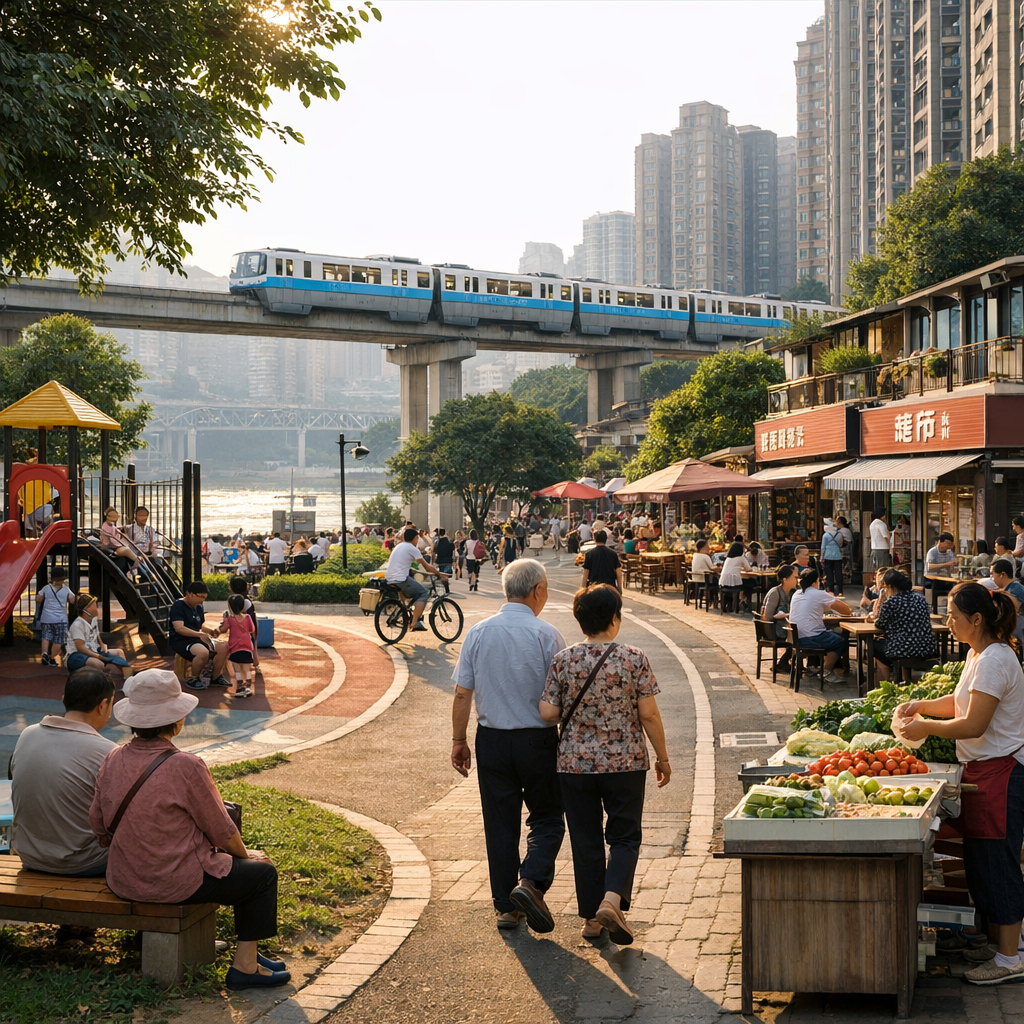
In the bustling city of Chongqing, a transformative initiative known as the ’15-minute life circles’ is reshaping urban living. This concept aims to provide residents with access to essential services—such as education, healthcare, childcare, and cultural activities—within a 15-minute walk from their homes. As of early 2026, this initiative has positively impacted over 3.1 million residents across 276 neighborhoods.
Bringing Services Closer to Home
The ’15-minute life circles’ are designed to create comprehensive community-based service systems. By integrating public services into neighborhoods, residents can conveniently access facilities without the need for long commutes. This approach not only enhances daily convenience but also fosters a stronger sense of community.
Focus on Childcare and Family Support
A significant aspect of this initiative is the emphasis on childcare services. Chongqing has been proactive in embedding childcare facilities within public community spaces. A notable example is the ‘Yuhao Space’ in Nanqiaosi Community, located in the Liangjiang New Area. This center collaborates with professional education institutions to offer daily childcare services at affordable rates. Additionally, low-income and disadvantaged families receive these services free of charge, ensuring inclusivity and support for all community members.
Innovative Community Partnerships
To ensure the sustainability of these community centers, Chongqing has adopted innovative partnership models. By involving third-party commercial entities, the city combines market-based operations with public welfare services. For instance, in Zhengjie Community in Tongliang, the ‘Yuhao Space’ integrates various services, including property management, teahouses, community canteens, and supermarkets. This holistic approach not only provides essential services but also creates a positive commercial operating cycle, contributing to the community’s economic vitality.
Revitalizing Underutilized Spaces
Rather than undertaking large-scale demolitions, Chongqing focuses on revitalizing underused community spaces. Old property rooms, vacant activity rooms, and unused sites are transformed into dedicated areas for children’s learning and play. This strategy maximizes service efficiency while minimizing costs, demonstrating a resourceful approach to urban development.
Looking Ahead
As of now, 48 ‘Yuhao Spaces’ are operational across Chongqing, benefiting over 300,000 women, children, and families. The city plans to expand this coverage, aiming for childcare institutions to serve more than 47% of urban communities by 2025, surpassing the national average. This ambitious goal reflects Chongqing’s commitment to enhancing the quality of life for its residents through thoughtful urban planning and community engagement.
By embedding essential services within easy reach, Chongqing’s ’15-minute life circles’ are not only improving daily convenience but also fostering a more connected and supportive community environment. This initiative serves as a model for other urban areas seeking to enhance livability and resident satisfaction.